The main source of law regulating sports in Ukraine is the “Law on Physical Activity and Sports” (hereinafter referred to as the Law on Sports). Since Ukraine’s independence, lawmakers have amended the law 36 times. We have analysed all the changes to gain a deeper understanding of the changes in Ukrainian sport over the past 30 years.
Summary
The Law on Sports has not been fundamentally changed since 1993. It was rewritten once in 2011 and increased by 50% in size, but the main theses and norms remained unchanged.
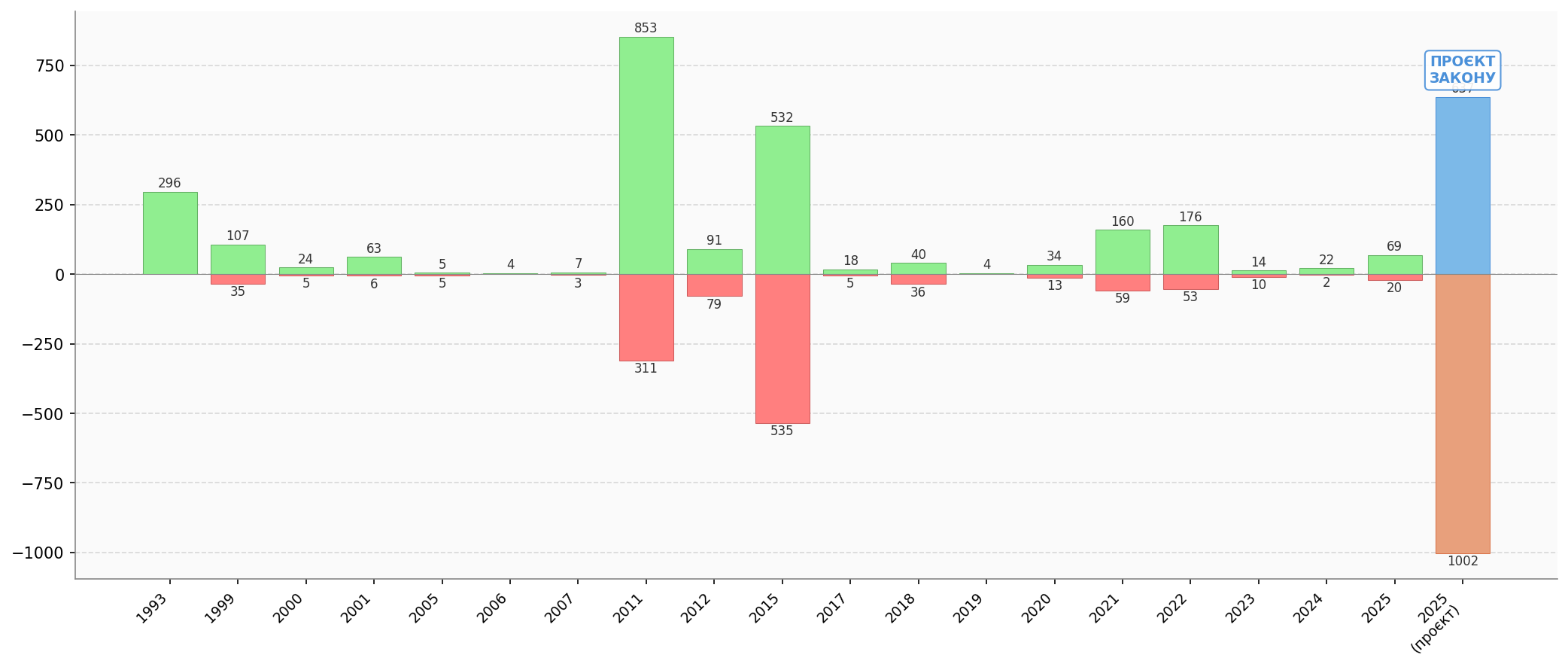
History of changes to the Law on Physical Culture and Sports
Green – added lines, red – removed lines
Started in 1993
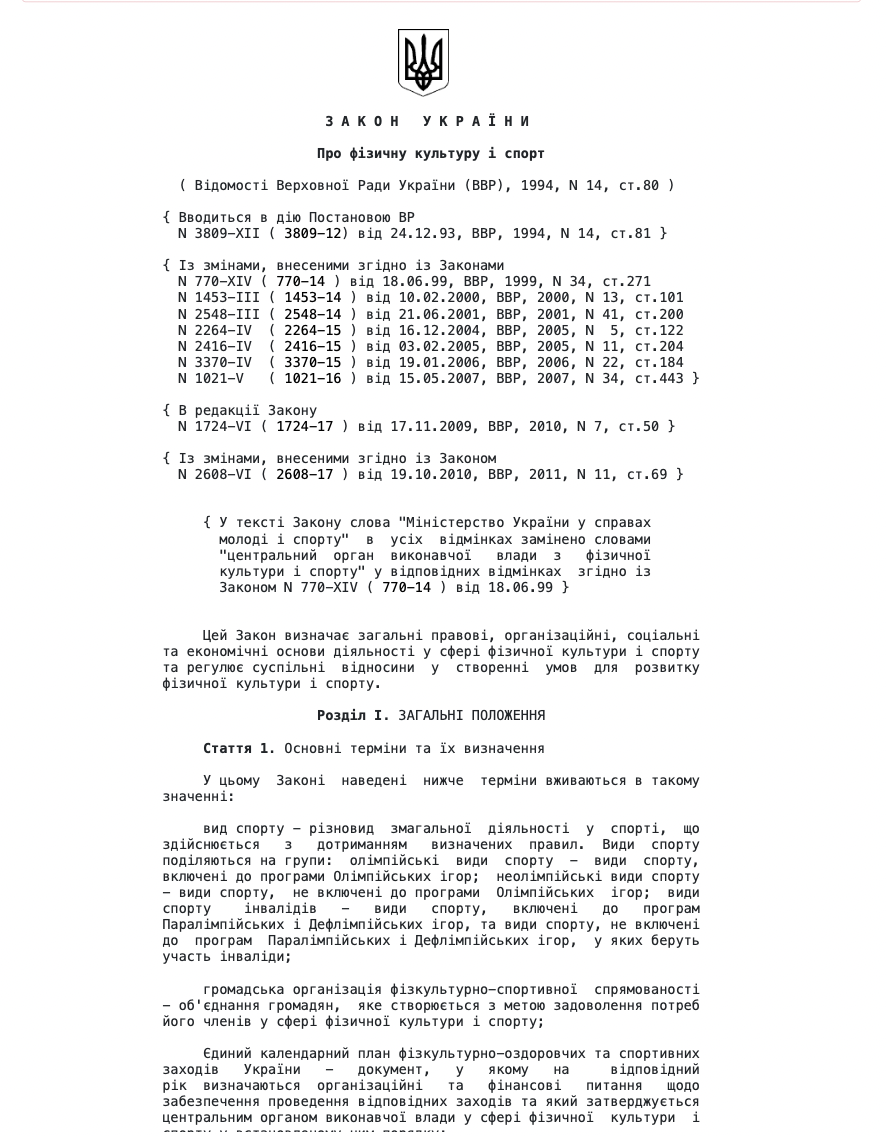
The first version of the Law dates back to 1993. The Law contained 41 articles defining the general principles of physical culture and sports in Ukraine.
In the first version of the Law, the task of sport was defined as follows:
The main tasks of physical culture and sports are to constantly improve the level of health, physical and spiritual development of the population, promote economic and social progress of society, and establish Ukraine’s international authority in the world community.
It is interesting that NGOs were named as the executors of the tasks - a separate Article No. 5 “Public principles in the field of physical culture and sports” is dedicated to this. The article on state regulation of sport also includes such phrases as “…the state regulates relations… by… recognising the broad amateur status of the physical culture and sports movement… and by comprehensive interaction of state bodies with public organisations…”.
The Law names indicators of the state of development of sports:
- the level of health and physical development of different segments of the population
- the degree of use of physical culture in various spheres of activity
- the level of development of the physical education system
- level of development of amateur sports
- high achievements of Ukrainian athletes in the relevant sports
We have not yet found the author of the draft law of the first Ukrainian law on sport, but it would not be surprising if the theses from the laws on sport of some European countries were used in the development of this law. At least, the emphasis on the public and amateurism has been there from the very beginning.
However, most of the law takes us back to the times of the USSR, in which the Goskomsport (and its previous reincarnations) managed and controlled sport. This includes such things as the state system of sports titles, badges, a state network of children’s and youth schools, sports and fitness associations, licensing of sports activities, guarantees of free education in children’s and youth schools, significant restrictions on the rights of federations, etc. The state’s monopoly is not questioned in many areas such as coach education, construction of sports infrastructure, holding of national competitions, etc.
1993 - 2011
Over the next 20 years, there were 7 amendments to the Law. Below is a table of the number of changed lines in each amendment and a brief description of the changes.
| Date | Deleted | Added | Description |
|---|---|---|---|
| 17.07.1999 | -32 | +104 | Renaming “Ministry of Ukraine” to “Central Executive Body”, detailed articles on federations |
| 21.03.2000 | -3 | +22 | A chapter on “Physical Culture and Sports Associations” was added |
| 27.07.2001 | -6 | +63 | The section on “professional sport” was rewritten |
| 12.01.2005 | -2 | +2 | The spelling of the word “Paralympic” was corrected |
| 25.02.2005 | -3 | +3 | The acquisition of the status of a national federation is detailed |
| 17.02.2006 | 0 | +4 | Article on licensing of sports activities was added |
| 08.06.2007 | -3 | +7 | The thesis on “prevention of reduction of the network of physical culture and sports institutions” was added |
| 17.11.2010 | 0 | 0 | The article on licensing of sports activities was cancelled |
A detailed analysis of the reasons for each change is beyond the scope of this article, but we can safely assume that these changes were “patches” in response to systemic conflicts within the Ukrainian sports community.
New edition 2011
In 2008, a draft of the new law was registered. The initiators were Viktor Korzh, Pavlo Kostenko and Oleksandr Volkov.
It was only in 2011 that the new law was adopted. There is no point in analysing the changes by article, because the text of the law was rewritten from scratch and has a different structure. The law has grown by 50%.
After reading this version and the previous one, we can try to answer the question: what has changed significantly in this version?
The short answer is nothing. The structure has changed, more clear definitions of terms have been added, but there have been no fundamental changes.
For example, the article on “Physical Culture and Recreation Activities in the Industrial Sphere” was renamed “Physical Culture and Recreation Activities at the Place of Work of Citizens”. The article on “public principles in the field of sports” has disappeared, although a clear definition of the term “sports club” has appeared. By analogy with municipal institutions, the Law for some reason defines the sources of funding for clubs, which does not mention support from local budgets.
Chaos with subjects
Section two, “Subjects of the sphere of physical culture and sports”, is actually a list of a zoo of types of sports organisations in Ukraine. These are:
- “sports clubs”
- “children’s and youth sports schools (CYSS)”
- “specialised sports educational institutions”
- “schools of higher sportsmanship”
- “Olympic training centres”
- “student sports centres of higher education institutions”
- “physical culture and recreational facilities”
- “centres of physical health of the population”
- “centres of physical culture and sports for disabled people” (the correct spelling of “people with disabilities” will be added later)
- “physical culture groups”
- “physical culture and sports associations”
- “sports federations”
- “public organisations of physical culture and sports orientation of pupils and students”
- “public organisations of physical culture and sports orientation of veterans of physical culture and sports”
The fact of blurred responsibilities adds to the chaos of this complex system of branching “sports entities”. For example, the Ministry of Youth and Sports is responsible for the Youth Sports School, but it is stated that the Youth Sports School belongs to the education system, which is subordinated to the Ministry of Education.
The conflict between the education system and the sports development system is a common phenomenon in the history of the formation of sports systems in many countries, but it did not exist in the USSR - the CYSS is a central component of the system for selecting talented children for higher achievement sports. The structure of funding, remuneration conditions, etc. are determined by the Ministry of Youth and Sports, and are aimed at early selection of talent. The law, however, describes CYSS as institutions that “…create the necessary conditions for harmonious upbringing, full recovery, meaningful rest, leisure of children and youth, self-realisation, and acquisition of healthy lifestyle skills…”
State Policy in the Field of Sport
However, the law also formulated the key theses of the state sports policy, among the first of which are the following:
- recognition of physical culture and sport as a priority area of the state’s humanitarian policy;
- recognition of physical culture as an important factor in the comprehensive development of the individual and the formation of a healthy lifestyle;
- recognition of sport as an important factor in achieving physical and spiritual perfection of a person, formation of patriotic feelings among citizens and a positive international image of the state;
- guaranteeing equal rights and opportunities for citizens in the field of physical culture and sports;
- promoting continuity and consistency of physical culture and sports activities of citizens of different age groups;
- providing support to public organisations of physical culture and sports orientation;
- ensuring diversity, high quality and accessibility of physical culture and sports services for citizens;
In the state policy of the current version of the law, there is not a single word about high-performance sports, except for one paragraph about “forming a positive international image”.
To summarise, the law captured the state of affairs at the time - chaos with no understanding of who, how and why was developing sport - and, at the same time, declared relatively European views on the values of sport. However, there were no fundamental changes - the same unjustifiably high level of state involvement in sports management, the same restrictions on federations’ freedom to develop their sports, the same rudiments of the Soviet sports system that was created to meet the demands of the Communist Party in a planned economy.
This version of the law, with minor changes, is still in force today.
2011-2022
Changes since 2011 are mostly corrections and patches.
| Date | Deleted | Added | Description |
|---|---|---|---|
| 15.05.2011 | -10 | +5 | Removed the requirement for volunteer certification |
| 5.12.2012 | -79 | +91 | In the long name of the “central executive body in the field of physical culture and sports” added “, which implements the state policy”, because it is not clear :) |
| 1.01.2015 | -529 | +528 | It was added that the salaries of coaches of CYSS are determined by the Cabinet of Ministers and that they are “free of charge” for certain groups of the population |
| 11.06.2015 | -6 | +4 | Removed the reference to the Cabinet of Ministers determining the salaries of coaches of CYSS and to “free of charge” for certain groups of people. Added a ban on the reduction of CYSS without the consent of the Ministry of Sport |
| 14.09.2017 | -3 | +7 | The concept of “national sports” was added |
| 27.09.2017 | -2 | +11 | The concepts of “service-applied and military-applied sports” were added |
| 16.02.2018 | 0 | +4 | The concept of “sporting weapons” was added |
| 3.06.2018 | -36 | +36 | Renamed “disabled persons” to “persons with disabilities” |
| 16.07.2019 | 0 | +4 | The requirement to hold sports competitions in the state language was added |
| 12.07.2020 | -12 | 33 | Articles on the Ukrainian Federation of Student Sports and the Student Sports Union were added |
| 16.10.2020 | -1 | +1 | The requirements for sports uniforms have been changed in favour of the requirements of international federations |
| 1.01.2021 | -59 | +59 | Updating the wording (such as “public organisation” to “public association”) |
| 6.06.2022 | 0 | +2 | A clause was added stating that the property of liquidated CYSS should be used for sports |
| 17.06.2022 | -1 | +10 | Article on “Sports of war veterans” was added |
| 15.06.2022 | 0 | +111 | Requirements for the activities of the National Anti-Doping Control Laboratory have been added |
2022-2025
Since Russia’s full-scale invasion of Ukraine in 2022, the Law has been amended 11 more times. Many amendments address topics relevant to the war context - war veterans’ sports, child protection, and adaptive sports.
| Date | Deleted | Added | Description |
|---|---|---|---|
| 01.10.2022 | -46 | +47 | Clear distinction between “sports events” and “sports competitions” was established |
| 27.10.2022 | -6 | +6 | Replaced “statistical observations” with “administrative data monitoring” |
| 31.03.2023 | -1 | +1 | Minor reference update related to Media Law |
| 04.05.2023 | -8 | +12 | Updated social standards and guarantees for sports workers |
| 03.09.2023 | -1 | +1 | Technical changes related to agricultural land laws |
| 01.01.2024 | -2 | 0 | References to social insurance removed (moved to separate law) |
| 06.10.2024 | 0 | +22 | Child protection in sports: new chapter on safeguarding children |
| 08.08.2025 | -6 | +10 | Adaptive sports: renamed from “sports for persons with disabilities” |
| 12.09.2025 | -7 | +7 | Updated references to professional education system |
| 02.10.2025 | -6 | +44 | War veterans’ sports: significantly expanded provisions for veterans |
| 12.10.2025 | -1 | +3 | Paid leave rights for athletes representing Ukraine added |
Notable is the October 2024 amendment on child protection - Ukraine became one of the few countries to include explicit child safeguarding provisions in its primary sports legislation.
Draft New Law “On Sport” (2025)
In November 2025, the Ministry of Youth and Sports published a draft of a fundamentally new Law “On Sport”, intended to replace the current Law “On Physical Culture and Sports”. Unlike previous amendments, this draft is a complete rewrite with a new structure and concept.
Key innovations in the draft:
- Autonomy of sport – for the first time in Ukrainian legislation, the principle of autonomy of sports organizations is enshrined, according to which sports develop independently from the state within the framework of legislation and principles of good governance
- “Digital Sport” system – provides for the creation of a unified information system for administering government management processes in the sports sphere
- Good governance principles – 4 principles are defined in detail (legality, democracy, transparency and accountability, self-governance), compliance with which is a condition for receiving state funding
- Professional sports leagues – the status and activities of professional leagues are regulated for the first time
- Sports arbitration court – a mechanism for resolving sports disputes is provided
Comparison with current law:
| Indicator | Current Law | Draft |
|---|---|---|
| Title | “On Physical Culture and Sports” | “On Sport” |
| Articles | 63 | 59 |
| Sections | 7 | 7 |
| Lines | ~1336 | ~971 |
The draft represents a significant step towards implementing the European model of sport in Ukraine and aligning with EU legislation, as envisaged by the Association Agreement.
Law on Github
If you would like to analyse the changes yourself, we have moved all versions of the Law to the popular version control platform Github. There you can view the history of changes in a convenient form or perform your own analysis (like git blame on the desired line of the law).
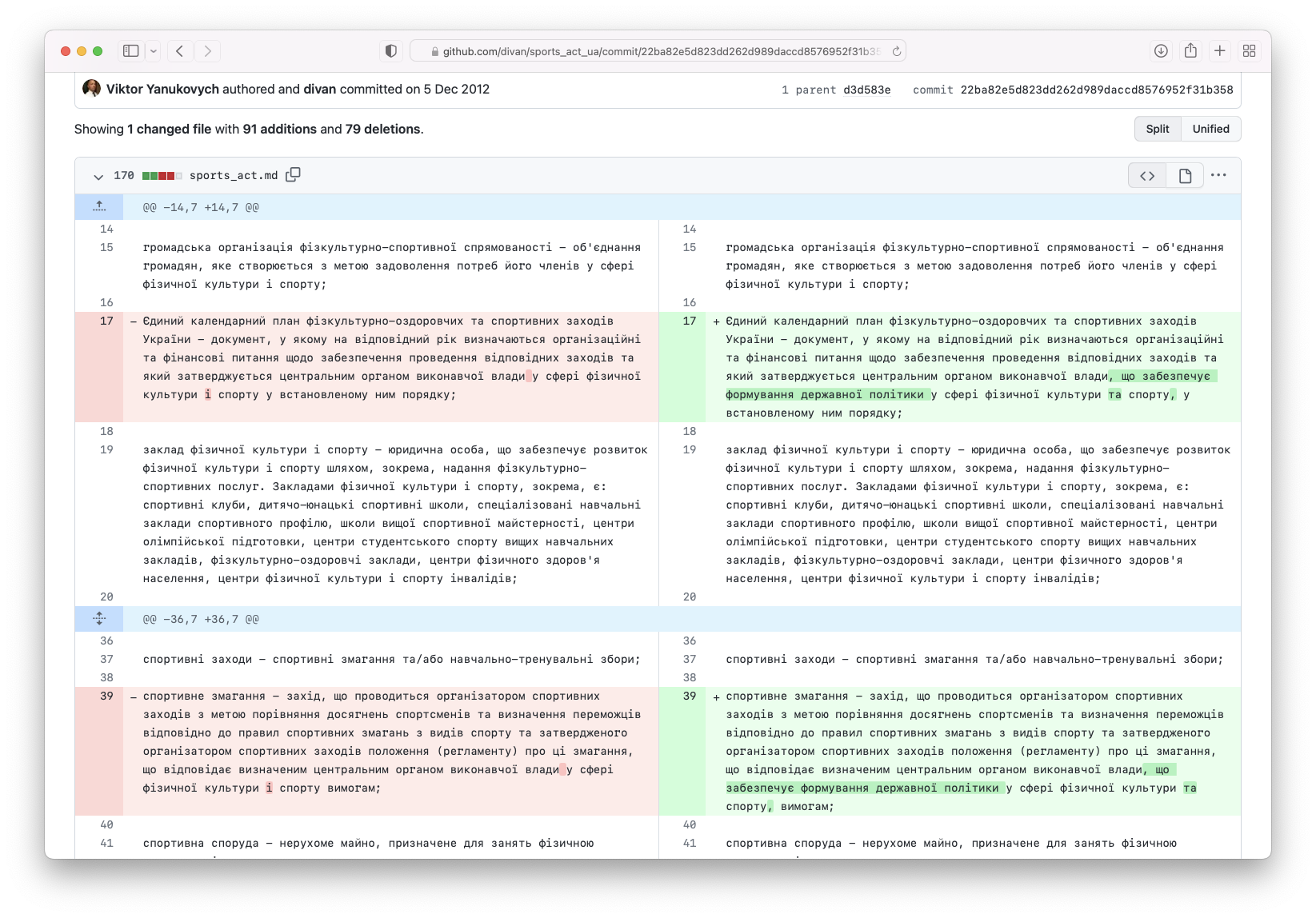
Link: https://github.com/eusport/sports_act_ua
Summary
The analysis of the amendments to the Law on Physical Culture and Sports suggests that the law on sports has not fundamentally changed in the history of independent Ukraine. The text was rewritten in 2011, but all the main components of the Soviet model of sports governance remained virtually unchanged.